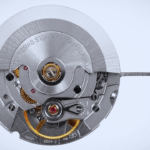
In the realm of haute horlogerie, the name Rolex resonates with a distinct aura of precision and unwavering reliability. Indeed, “The Crown” operates with a unique philosophy, particularly when it comes to the intricate heart of its timepieces: the regulating organ.
Consider this: Rolex subjects its “Superlative Chronometers” to accuracy tests with tolerances twice as stringent as the official COSC certification standards, to which their movements are already systematically submitted.
Furthermore, the brand’s bold move in 2015 to offer a full 5-year warranty underscored their confidence in the robustness of their creations. As astute collectors, one understands that such unwavering performance is no mere coincidence. It is the result of a meticulously engineered regulating organ, a testament to Rolex’s commitment to horological excellence.
This guide will delve into the distinctive features of the Rolex regulator, shedding light on the innovations that contribute to the exceptional precision and reliability that define “The Crown.”
The Rolex Regulator: The Guardian of Time
The regulating organ, the very pulse of a mechanical movement, dictates the rate at which a timepiece measures time. Comprising the escapement and the oscillator, it is, in essence, the “guardian of time.” It is therefore unsurprising that Rolex has pioneered its own distinct solutions in this critical area.
The following are some of the hallmark features of a Rolex movement’s regulator, elements so characteristic that they often allow for immediate identification, even beneath a solid caseback.
Free-Sprung Balance Wheel with Microstella Nuts
There are primarily two methods for regulating a mechanical movement. The more conventional approach involves a regulator mechanism, where the active length of the hairspring is adjusted via a sliding regulator index. However, Rolex opts for the superior solution: the free-sprung balance.
In this system, the length of the hairspring remains constant, and instead, the inertia of the balance is precisely altered by adjusting screws or weights. This high-grade approach is favored as it inherently improves precision by mitigating certain errors and exhibits greater resilience to shocks that could displace a regulator index.
Rolex employs a meticulously machined balance wheel, enhancing its poise, fitted with their signature gold ‘Microstella’ nuts. These paired adjustment screws enable incredibly precise rate adjustments. Moving these screws inwards reduces the balance’s inertia, causing the watch to run faster, and vice versa.
In-House Parachrom Blue Hairspring
Magnetism poses a persistent threat to the accuracy of mechanical timepieces. Historically, watchmakers combated this by encasing movements in soft iron cages. However, this method proves inadequate against high-intensity magnetic fields and adds bulk to the case.
Modern research has focused on the movement itself, particularly the strategic selection of materials for the balance wheel and its surrounding components. In this regard, Rolex stands as one of a select few manufacturers producing their own hairsprings in-house, belonging to an exclusive group with access to paramagnetic and anti-magnetic materials.
Rolex unveiled the patented “Parachrom Blue Hairspring” in 2000, debuting it within the calibre 4130 of the Cosmograph Daytona. Its proprietary alloy boasts anti-magnetic properties and exceptional stability under temperature fluctuations. By 2005, Rolex enhanced the material with a thicker blue surface structure, hence “Parachrom blue.” Further innovation came in 2014 with the introduction of silicon hairsprings in the calibre 2236, primarily for their ladies’ collections. Rolex’s efforts to combat magnetism extend beyond the hairspring; even the balance staff is engineered for optimized resistance to magnetic interference.
Rolex Overcoil
The geometry and attachment point of the hairspring significantly influence its expansion and contraction. While many timepieces utilize flat spiral springs, Breguet conceived the idea of bending the outer coil and attaching it near the balance staff.

This ingenious design allows the spring to “breathe” more symmetrically and evenly, thereby improving isochronism. Rolex implements this superior solution with their “Rolex overcoil,” an optimized version of the Breguet overcoil, adhering to their distinct nomenclature.
Transversal Balance Bridge
Traditionally, the balance wheel is secured by a “cock,” fixed at only one end. However, contemporary Rolex movements feature a transversal balance bridge, meaning it is secured at both ends.
This design provides a more stable and precise positioning of the oscillator. The enhanced rigidity of the bridge significantly improves the movement’s shock resistance.
Rolex Paraflex Anti-Shock
The pivots and jewel bearings of the balance wheel, and sometimes other critical components, are particularly vulnerable to damage from impacts. Anti-shock systems mitigate this by mounting the jewels on springs, allowing them to shift within their settings to absorb shocks. While the Swiss watch industry commonly employs Incabloc and KIF systems, Rolex, after years of utilizing KIF, developed and patented their exclusive shock absorber, Paraflex, in 2005. Recognizable by its unique geometry, Rolex claims that Paraflex increases the shock absorber’s efficiency by up to 50 percent while preserving the chronometric properties of the balance wheel.
The 4Hz Frequency Standard
In theory, increasing a movement’s frequency can enhance its precision, provided the rate remains stable. However, higher frequencies can also lead to increased friction and reduced power reserve. Rolex has standardized on a 4Hz frequency, or 28,800 vibrations per hour, for all its modern movements.
They consider this the optimal balance between high-precision regulation and long-term reliability. This philosophy was evident in the 1990s when Rolex modified the Zenith “El Primero” movement for the Daytona, tuning its frequency down from 5Hz to 4Hz.
Chronergy Escapement
First introduced in the calibre 3255 powering the Day-Date 40 in 2015, the Chronergy escapement represents Rolex’s refined iteration of the Swiss lever escapement. The goal for Rolex engineers was to enhance the escapement’s efficiency without compromising its inherent reliability.
This was achieved by reversing the length ratios between the escape wheel teeth and the pallet stones. The pallet stones were made half as thick, while the contact surfaces of the escape wheel teeth were doubled. Furthermore, the escapement elements are intentionally slightly off-set to amplify the lever effect.
Utilizing LIGA technology, the escape wheel and anchor are manufactured with ultra-high precision, and their openwork design reduces inertia. Notably, these nickel-phosphorous components are also impervious to magnetic interference. Rolex states that the Chronergy escapement boasts a 15 percent increase in efficiency.
Lubrication – Epilamage Coating
The esteemed watchmaker Abraham-Louis Breguet famously said, “Give me the perfect oil and I will give you the perfect watch!” While Rolex often remains tight-lipped about its technical advancements, their website offers a fascinating glimpse: “Rolex has developed exclusive new lubricants, synthesized in‑house, whose useful life and stability over time have been considerably improved.”
While the specifics remain undisclosed, this highlights the paramount importance Rolex places on lubrication and epilamage coating in ensuring the longevity and precision of their timepieces.
FAQ Section
Q: How does Rolex’s free-sprung balance with Microstella nuts contribute to the accuracy of their timepieces for a discerning collector? A: The free-sprung balance system, adjusted via the Microstella nuts, offers superior precision and stability compared to traditional regulator systems. By directly altering the balance’s inertia, it allows for finer and more consistent rate adjustments, and is less susceptible to shocks that could disrupt accuracy.
Q: The Parachrom Blue hairspring is a signature Rolex innovation. Beyond its distinctive color, what are its key benefits for an investment-grade timepiece? A: The Parachrom Blue hairspring’s primary advantage lies in its paramagnetic properties, rendering it highly resistant to magnetic fields that can negatively impact a mechanical watch’s accuracy. Its stability under temperature variations also contributes to more consistent timekeeping, crucial for a reliable investment.
Q: Rolex’s emphasis on in-house manufacturing is well-known. How does this vertical integration benefit the quality and reliability of their regulating organs? A: In-house manufacturing allows Rolex complete control over the entire production process, from material selection to final assembly. This ensures stringent quality control at every stage, leading to movements, including the regulating organ, built to exacting standards of precision and long-term reliability.
Q: The Chronergy escapement aims for enhanced efficiency. For a collector, what are the tangible benefits of a more efficient escapement in a luxury watch? A: A more efficient escapement translates to better energy transfer within the movement, which can contribute to a more stable and accurate rate over time and potentially a longer power reserve, enhancing the overall performance and user experience of the timepiece.
Q: Rolex utilizes a 4Hz frequency across its modern range. In the context of haute horlogerie, is this considered a high or moderate beat rate, and what are the implications for accuracy and smoothness? A: A 4Hz (28,800 vph) frequency is generally considered a high beat rate, striking a balance between accuracy and smoothness of the seconds hand sweep. While higher frequencies exist, Rolex deems 4Hz the optimal compromise for achieving both precise timekeeping and robust reliability across their collections.